Revolutionizing Nursing Education with Digital Simulation Labs for Future Registered Nurses

Updated: Jul 23
Nursing education faces growing demands to prepare students for complex clinical environments. A $59,929 proposal aims to transform a traditional classroom into a flexible digital simulation laboratory designed for 20 prelicensure nursing students. This innovative space will blend technology, clinical judgment, and purposeful learning to enhance student readiness for real-world patient care. Flexible learning spaces can support a wider range of instructional activities when they are intentionally designed around the needs of students and educators (Casanova et al., 2023).
Figure 1
Diverse Nursing Students Collaborating in a Digital Simulation Lab

Note. Illustration depicting prelicensure nursing students participating in a digital simulation laboratory designed to support clinical reasoning, collaboration, and technology-enhanced learning. Image created using artificial intelligence (OpenAI, 2026).
This blog explains the design and features of the digital simulation lab, the Prepare–Analyze–Perform–Debrief learning sequence, and how this approach supports clinical reasoning, collaboration, documentation, medication safety, accessibility, and repeated practice. The laboratory complements direct patient care and high-fidelity simulation by offering nursing educators and academic leaders a practical model for expanding access to structured, repeatable learning experiences (Texas Board of Nursing [TX BON], 2023a).
Transforming the Classroom into a Digital Simulation Lab
The proposed lab will equip nursing students with tools and environments that reflect clinical practice while supporting flexible approaches to learning. The design was developed using backward-planning principles, meaning that learning outcomes and instructional activities were identified before equipment was selected (Rinaldi et al., 2025). Key components include:
20 student laptops for individual and group work
One instructor laptop to facilitate and monitor activities
Five collaboration pods seating four students each, promoting teamwork
Portable task trainers for hands-on skill practice
Computer-based clinical simulation software to develop decision-making
Electronic Health Record (EHR) practice stations for documentation skills
Two 75-inch displays for shared viewing of scenarios and data
Mobile furniture to quickly reconfigure the space for different activities
Hybrid conferencing equipment to support remote participation and guest speakers
Assistive technology ensures accessibility for all students
An accessible, quiet area for reflection and focused study
Business-class laptops would allow students to access Canvas, complete browser-based patient cases, practice EHR documentation, participate in videoconferencing, and use accessibility tools. Technology adoption is more likely when students perceive digital systems as useful and manageable to use (Lobo et al., 2025).
The five collaboration pods would support case analysis, peer teaching, role-playing, documentation, medication-safety activities, and team-based decision-making. Research on flexible learning spaces suggests that thoughtfully designed environments can increase learners’ ownership of the space and broaden the range of possible learning activities (Casanova et al., 2023).
Figure 2
Proposed Layout of the Digital Simulation Laboratory for Twenty Prelicensure Nursing Students
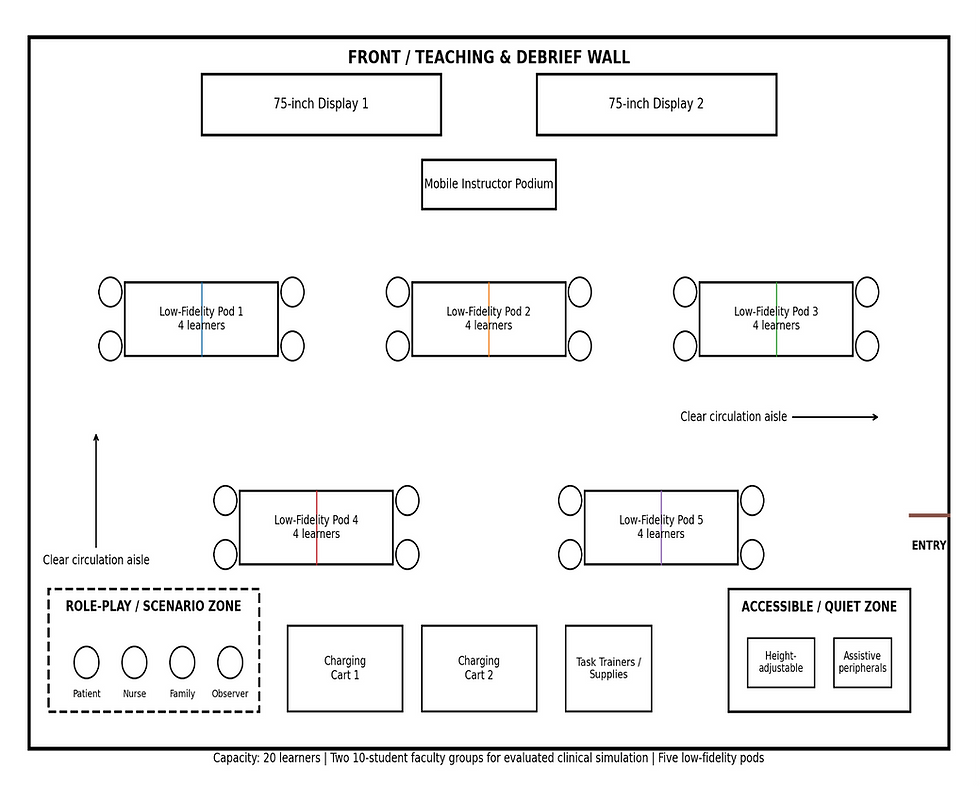
Note. Conceptual floor plan illustrating the proposed digital simulation laboratory. The layout includes five low-fidelity learning pods, a teaching and debriefing wall with dual 75-inch displays, a mobile instructor podium, a role-play/scenario zone, charging stations, task trainers and supplies, an accessible/quiet zone, and circulation aisles designed to support collaborative learning, accessibility, and simulation-based instruction. Figure created by the author.
The Prepare, Analyze, Perform, and Debrief Learning Sequence
The lab’s activities follow a structured learning sequence designed to build clinical judgment and reasoning skills:
Figure 3
Prepare–Analyze–Perform–Debrief Learning Sequence for the Digital Simulation Laboratory

Note. Conceptual workflow illustrating the four-phase instructional sequence used in the proposed digital simulation laboratory. Learners prepare by reviewing multimedia resources and clinical cues in Canvas, analyze patient information collaboratively to establish priorities, perform clinical decision-making through electronic health records, role-play, or computer-based simulation, and debrief by comparing decisions, reflecting on performance, and revising the plan of care. Figure created by the author.
Prepare
Students review case materials, clinical guidelines, and simulation objectives before sessions. Canvas can provide modules, assignments, rubrics, feedback, analytics, and links to simulation resources. Learning-management systems can support students’ engagement when their educational value and ease of use are evident (Lobo et al., 2025). This phase ensures they come ready to engage actively and understand the context of the scenarios.
Analyze
Students assess patient data, identify problems, and develop care plans. The Texas Differentiated Essential Competencies emphasize clinical reasoning, analysis of assessment findings, collaboration, and the use of technology to support safe patient-care decisions (TX BON, 2021). This step encourages critical thinking and clinical reasoning, essential for safe and effective nursing practice.
Perform
Students carry out clinical tasks using task trainers, laptops, and simulation software. They practice medication administration, EHR documentation, and teamwork within collaboration pods. Computerized scenarios, role-playing, case studies, task trainers, and static models are recognized forms of low-fidelity simulation that can support knowledge development in prelicensure nursing education (TX BON, 2023a).
Debrief
Faculty lead reflective discussions to review performance, highlight strengths, and identify areas for improvement. Simulation experiences used for nursing education should include clearly defined objectives, faculty guidance, appropriate evaluation, and planned debriefing (TX BON, 2023a). This feedback loop supports learning through repetition and correction.
Supporting Clinical Reasoning and Collaboration
The lab’s design promotes essential nursing competencies:
Clinical judgment improves as students analyze realistic patient data and make decisions in a safe environment (Sim et al., 2022).
Collaboration is fostered through group work in pods, mirroring interdisciplinary teamwork in healthcare settings (Sezgin & Bektas, 2023).
Documentation skills develop with EHR practice, emphasizing the accuracy and completeness required by the Texas Board of Nursing (2023a).
Medication safety is reinforced through simulation scenarios that require careful calculation, administration, and monitoring (Shahzeydi et al., 2024).
Active, competency-based nursing education should connect knowledge with action through guided practice, assessment, feedback, and self-reflection (American Association of Colleges of Nursing [AACN], 2021). These elements prepare students to transition confidently from classroom learning to clinical practice.
Accessibility and Structured Faculty Feedback
The inclusion of caption-ready media, assistive peripherals, adaptable workstations, flexible groupings, and a quiet area provides students with multiple ways to access information and participate. Universal Design for Learning can improve accessibility by offering varied means of engagement, representation, and participation without reducing academic expectations (Almeqdad et al., 2023; Cumming & Rose, 2022).
Students have also reported that Universal Design for Learning practices can support participation and access in virtual higher education environments (Wells, 2022). Faculty feedback during debriefing would provide students with specific, actionable guidance that supports reflection, correction, and continued growth.
Complementing Patient Care and High-Fidelity Simulation
The Texas Board of Nursing indicates that simulation may support clinical education when learning activities are appropriately developed, guided, and evaluated; however, simulation should remain connected to course objectives and should not replace required hands-on clinical learning without appropriate regulatory and programmatic alignment (TX BON, 2023b).
For formally evaluated low-fidelity clinical activities, the proposed local guideline is one faculty member for every 10 students. Texas regulations limit direct patient-care clinical groups to 10 students per faculty member, while schools establish appropriate ratios for simulation and skills laboratories according to learning objectives and student needs (TX BON, 2023b).
Practical Benefits for Nursing Educators and Academic Leaders
Canvas quizzes, audience-response systems, shared whiteboards, and collaborative documents can support retrieval practice and timely feedback. Digital tools should be selected according to educational value, accessibility, reliability, and manageable complexity rather than novelty alone (Cumming & Rose, 2022).
Networked learning environments may also support real-time access, collaboration, monitoring, and resource management when privacy, security, and infrastructure needs are adequately addressed (Hassan Al-Taai et al., 2023).
Academic leaders can view the laboratory as a strategic investment in program quality, accessibility, faculty innovation, and student preparation. Because the proposal uses existing institutional licenses for Canvas, Microsoft 365, videoconferencing, cloud storage, and endpoint management, the project can expand learning opportunities without unnecessarily duplicating existing resources.
This digital simulation lab represents a thoughtful investment in nursing education that aligns with current standards and future needs. By combining technology, clinical judgment, and purposeful learning, it supports the development of competent, confident future healthcare leaders.
Next steps include exploring funding opportunities, faculty training, and pilot testing to ensure successful implementation and ongoing evaluation.
References
American Association of Colleges of Nursing. (2021). The essentials: Core competencies for professional nursing education. https://www.aacnnursing.org/Portals/42/AcademicNursing/pdf/Essentials-2021.pdf
Almeqdad, Q. I., Alodat, A. M., Alquraan, M. F., Mohaidat, M. A., & Al-Makhzoomy, A. K. (2023). The effectiveness of universal design for learning: A systematic review of the literature and meta-analysis. Cogent Education, 10(1), Article 2218191. https://doi.org/10.1080/2331186X.2023.2218191
Casanova, D., Huet, I., & Garcia, F. (2023). The experience of co-designing a learning space with teachers and students. Education Sciences, 13(2), Article 103. https://doi.org/10.3390/educsci13020103
Cumming, T. M., & Rose, M. C. (2022). Exploring universal design for learning as an accessibility tool in higher education: A review of the current literature. The Australian Educational Researcher, 49(5), 1025–1043. https://doi.org/10.1007/s13384-021-00471-7
Hassan Al-Taai, S. H., Kanber, H. A., & Mohammed Al-Dulaimi, W. A. (2023). The importance of using the Internet of Things in education. International Journal of Emerging Technologies in Learning, 18(1), 19–39. https://doi.org/10.3991/ijet.v18i01.35999
Lobo, J., Teodosio, K., Estilo, K., Achas, M., Aliser, J., & Codod, C. L. (2025). Canvas Learning Management System and Zoom: Serviceability directed toward physical activities and health and fitness courses for synchronous and asynchronous classes. Journal of Educators Online, 22(2), 1–19. https://doi.org/10.9743/JEO.2025.22.2.2
Rinaldi, K., Messer, M., Hanson, A., & Chan, J. (2025). Utilization of backward design in health professional education: A rapid review. Journal of Professional Nursing, 58(1), 31–38. https://doi.org/10.1016/j.profnurs.2025.02.004
Sezgin, M. G., & Bektas, H. (2023). Effectiveness of interprofessional simulation-based education programs to improve teamwork and communication for students in the healthcare profession: A systematic review and meta-analysis of randomized controlled trials. Nurse Education Today, 120, Article 105619. https://doi.org/10.1016/j.nedt.2022.105619
Shahzeydi, A., Dianati, M., & Kalhor, F. (2024). Clinical simulation in nursing students’ safe medication administration: A systematic review. Iranian Journal of Nursing and Midwifery Research, 29(5), 522–529. https://doi.org/10.4103/ijnmr.ijnmr_323_23
Sim, J. J. M., Rusli, K. D. B., Seah, B., Levett-Jones, T., Lau, Y., & Liaw, S. Y. (2022). Virtual simulation to enhance clinical reasoning in nursing: A systematic review and meta-analysis. Clinical Simulation in Nursing, 69, 26–39. https://doi.org/10.1016/j.ecns.2022.05.006
Texas Board of Nursing. (2021). Differentiated essential competencies of graduates of Texas nursing programs. https://www.bon.texas.gov/pdfs/differentiated_essential_competencies-2021.pdf
Texas Board of Nursing. (2023a). Education guideline 3.7.7: Simulation in prelicensure nursing education. https://www.bon.texas.gov/pdfs/education_pdfs/education_nursing_guidelines/3-7-7-Guideline.pdf
Texas Board of Nursing. (2023b). Education guideline 3.7.2: Ratio of faculty to students in clinical learning experiences. https://www.bon.texas.gov/pdfs/education_pdfs/education_nursing_guidelines/3-7-2-Guideline.pdf
Wells, M. B. (2022). Student perspectives on the use of universal design for learning in virtual formats in higher education. Smart Learning Environments, 9, Article 37. https://doi.org/10.1186/s40561-022-00218-6
Disclaimer: This blog post is for informational purposes only and does not constitute medical or educational advice.


Comments